System Composition:

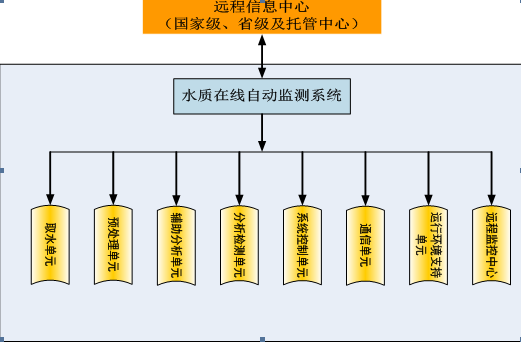
Water Quality Automatic Monitoring System Architecture Diagram

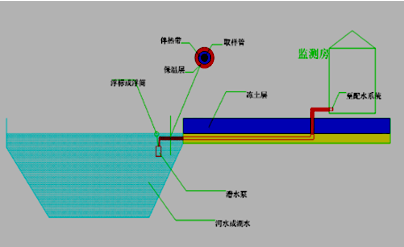
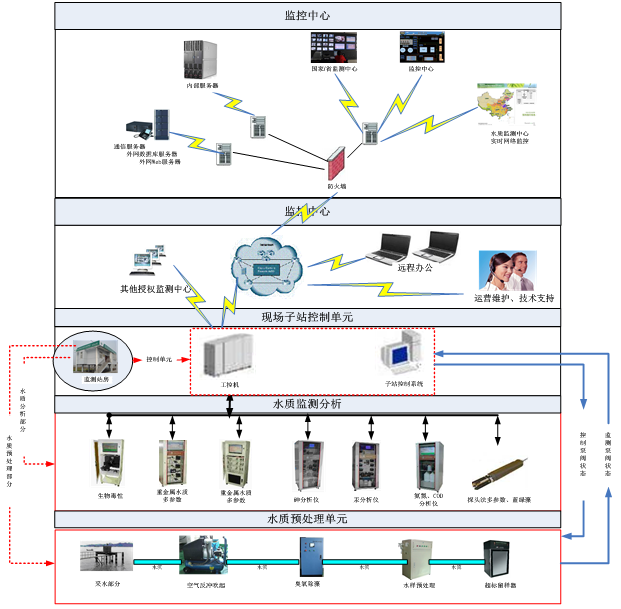
Schematic Diagram of Water Quality Automatic Monitoring System Structure
- Physical and biological indicators: conventional five parameters (pH, temperature, turbidity, conductivity, dissolved oxygen), chlorophyll and cyanobacteria;
- Organic and total quantity indicators: permanganate index (CODmn), ammonia nitrogen (NH₄-N), total phosphorus (TP), total nitrogen (TN), total organic carbon (TOC), etc.;
- Class I heavy metal pollution factors: a single device enables simultaneous monitoring of six parameters. Customized monitoring channels and system solutions are available according to user demands;
- Supplementary comprehensive monitoring indicators on the basis of deterministic monitoring: biological toxicity monitoring.
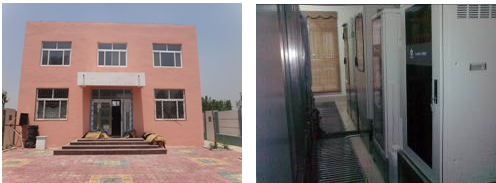
a) The station building adopts brick-concrete or frame structure with a service life of 50 years.
b) The ground elevation of the station shall resist floods with a 50-year return period.
c) The station shall be designed for earthquake resistance in accordance with local seismic fortification intensity.
d) The clear indoor height shall facilitate the installation, operation and maintenance of instruments and equipment, generally no less than 2.7 meters.
e) Proper thermal insulation measures must be implemented to prevent system damage caused by indoor temperature fluctuation due to power failure.
f) To ensure stable operation of analytical units, the indoor temperature of the instrument room shall be maintained at 18–28℃, and the relative humidity shall be kept within 60%.
g) The floor of the instrument room shall be paved with waterproof and anti-slip floor tiles, and floor drains shall be installed at designated positions.
h) The quality control room shall be equipped with laboratory workbenches, water supply and drainage facilities, and hand sinks.

b) Single-phase 220 V power with 10 KW capacity is supplied for instruments, equipment and control systems; a dedicated power distribution box for the automatic water quality monitoring system shall be configured in the instrument room.
c) Single-phase 220 V power with 3 KW capacity is used for air conditioning, lighting and daily utilities of the station.
d) To improve power supply stability and reliability of the automatic water quality monitoring station, an independent transformer control system (S11-M-30 KVA) is recommended, and the model and specification of other equipment shall be matched with the transformer.
b) During construction, steel bars in the foundation, structural columns and top ring beams of the station shall be welded together to form a shielding mesh, which is connected with grounding devices to build an equipotential body.
c) Grounding flat iron shall be installed inside the station.

a) Connected drainage trenches are arranged in the instrument room with two floor drains installed inside. The diameter of each floor drain opening is 110 mm, and the connected drainage pipe is 110 mm in diameter. The final drainage outlet shall be located more than 30 meters downstream from the water intake point.
b) Waterproof treatment shall be carried out on the floor and drainage trenches of the instrument room.
c) A 110 mm diameter interface shall be reserved at the water inlet of the system.