
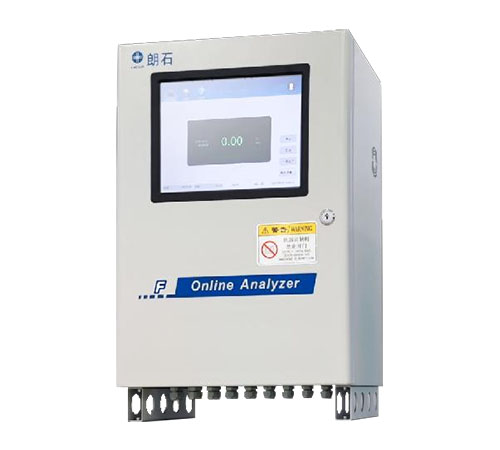
Fluoride On-line Water Quality Analyzer
Product Introduction
This on-line automatic analyzer can continuously detect, analyze, read, store and upload fluoride data in industrial sewage, municipal sewage and partial surface water. It features low reagent consumption, suitability for long-term on-line monitoring, simple structure, easy maintenance, long maintenance intervals, accurate test results and excellent stability.
Product Features
High Measurement Accuracy
• Supports automatic standard sample verification and automatic calibration to meet the requirements of new national standards.
• Equipped with automatic intelligent cleaning for higher detection accuracy.
• Low limit of quantification and wide measuring range to adapt to diverse application scenarios.
• Unique algorithm and optical path design deliver strong anti-turbidity interference capability.
High Stability & Reliability
• Adopts high-quality pumps, valves, detectors, chips and other components for high reliability and stability.
• Features stable and reliable quantitative technology to realize accurate measurement for various complex water bodies.
• Deep cleaning for key valves prevents blockage and reduces operating costs.
Easy Operation & Maintenance
• One-click calibration function automatically completes reagent renewal, pipeline cleaning and calibration for simple operation.
• Optimized low-pollution reagent formula reduces single consumption of reagents and waste liquid, which is eco-friendly and cuts operating costs.
• Supports remote operation and maintenance; users can scan QR codes via WeChat to report faults online for timely and targeted after-sales service.
Application Scenarios
Industrial wastewater, municipal sewage, technological process water, sewage treatment plants and sewage outlets.